Nighttime Predator Hunting in the Southeast: A Deep Dive with Nightshade Optics
Night hunting for coyotes and feral hogs is growing rapidly in the Southeast, thanks to a combination of legal openness and advanced gear. Many Southern states now allow year-round night hunting of these “invasive” species on private land. Progressive regulations (for example, Georgia and Florida explicitly permit hog and coyote hunts at night on private property) mean hunters have 365 nights a year to pursue predators. In practice, this means when daytime hunts for deer or turkey have ended, skilled hunters can switch to evenings with night-vision scopes and calls. As Carolina huntsman Gene Wisnewski notes, improved equipment and loose restrictions in the Carolinas have made nighttime hog and coyote hunting extremely effective for population control. Even in the summer, cool nights bring hogs and coyotes out into open fields. Experienced hunters can extend their season substantially by embracing the night, which often yields more consistent action.
Why Hunt Coyotes and Hogs at Night?
- Higher success & more opportunities. Coyotes are naturally vocal and active after dark. As predator expert Heath Wood explains, packs often howl and yip at night (especially during the winter breeding season), making them easier to locate with sound. One night stand with a well-placed coyote call can draw in curious animals quickly. Likewise, hogs often feed heavily on crops or feeders at night once daylight is gone. Trail cams routinely show wild pigs moving into feeding areas between dusk and midnight, especially during darker moon phases. In the Southeast, farmers know hogs will root around in corn or mast after sunset, so a nighttime setup around a feeder is prime hunting ground.
- Comfort and expanded seasons. Southern summers can be brutally hot, and day hunting during midday can be exhausting. Night hunting avoids the heat: on warm nights even a July hunt can be comfortable, and hunters report “a tranquil” feeling sitting in the dark woods. And because there are typically no closed seasons for hogs and coyotes in many states, night hunting is effectively a year-round opportunity. Even when deer and turkey seasons are over, or when work schedules limit daytime hunts, predators can still be taken after dark on lands where permission is granted. As one Southeastern writer puts it, night hunting gives access to “countless trips…we make each year to our properties”, turning any evening into a potential hunt.
- Invasive-species control. Game agencies encourage predator control, and night hunting has become a key tool. Whitetail deer numbers fluctuate with season, but hogs and coyotes breed year-round and reproduce rapidly. Hunters extending their efforts into the night help take the pressure off landowners and ecosystems. In fact, biologists note that coyotes and wild pigs have expanded across the Carolinas (and the South in general) in recent years, so removing them at night is now common practice. With growing hog damage costs (over $500 million annually in Texas alone), regulators are embracing nocturnal hunting as a practical solution.
Essential Nighttime Hunting Gear
Hunting after dark requires specialized equipment to see and aim safely. Modern optics and supports make nocturnal hunts far more effective – and Nightshade Optics’ own expertise comes from years of building and field-testing this gear. Key tools include:
- Thermal and Night Vision Scopes. Thermal-imaging scopes detect heat signatures and are widely considered the “gold standard” for night hog and coyote hunting. These devices let you pick out warm bodies against the cold background at distance. Nightshade stocks top-tier thermal riflescopes (such as the RIX Storm and Leap series) that deliver crisp images with long battery life. RIX Storm scopes (for example) have high-res sensors and rugged carbon-fiber bodies, so they work on big-caliber rifles or fast-handling varmint guns. Night vision (digital or Gen-2/3 tube scopes) is another option. Digital scopes with IR illumination or Gen-3 tubes amplify starlight or IR lasers to show black-and-white images. They tend to cost less than thermals, and skilled hunters often use them for coyote work. However, be aware of their limitations: as one expert notes, digital/NV scopes can suffer from “light bloom” off leaves or brush in heavy cover, sometimes obscuring the target. In open areas (like a cornfield or yard with a clear view), a digital NV scope with a spotter lamp can still perform well. For multi-purpose use, Nightshade carries hybrid scopes – for example, DNT Optics ThermNight models – that combine a day/night camera, thermal sensor, and even a built-in laser rangefinder in one unit. Such 3-in-1 scopes allow seamless switching between thermal and digital views, letting you hunt through dusk into full night without changing equipment.
- Illumination and Lasers. Even with thermal, a little light helps confirm your target. Hunters use a mix of visible and infrared lighting. LED spotlights or headlamps (often red/green-tinted for minimal spooking) help identify animals at moderate range. For hog feeders, low-voltage feed lights are popular – these softly illuminate the corn mound so hog silhouettes show up on your scope without startling them. (Hogs quickly adapt to consistent light levels at a feeder, so a dim solar-powered lamp will keep them coming even under glow.) Nightshade’s Sniper Hog “Hyperion” lights produce bright white or variable-colored beams for when you need to clearly see an animal up close. Meanwhile, IR lasers and illuminators let you aim with a red/green dot without giving away your position, if local regulations allow it. (Several Southern states now allow IR aiming devices for hogs and coyotes.) In short, carry a good rifle-mounted light or pointer, plus a separate handheld lamp – teams often have one hunter spotlight while the other shoots.
- Stable Mounts – Tripods and Clamps. Heavy night-vision gear and night hunts often mean long, still waits. A sturdy tripod is essential. Nightshade offers FatBoy and Warrior mounting solutions for this – e.g. FatBoy’s Elevate tripods and Warrior’s precision Arca-plate heads. These all-aluminum rigs support heavy thermal scopes and give you a solid, vibration-free shooting platform. Quick-release mounts (like the Warrior bolt-action Arca plate) allow fast attachment of different rifles. Even for a single-hunter setup, a tripod or at least a solid bipod is recommended to avoid fatigue and improve accuracy when scanning and shooting in the dark.
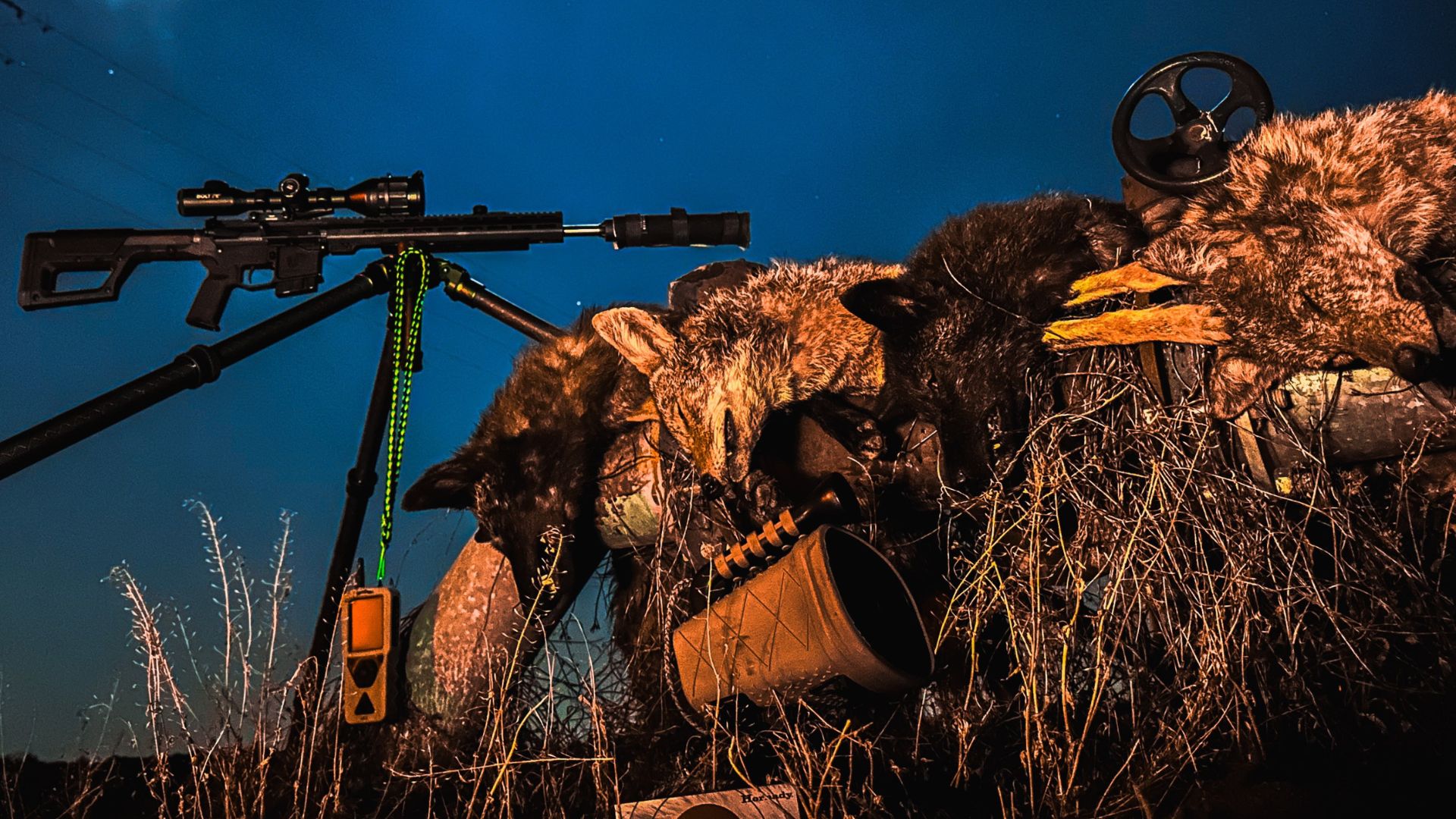
A nighttime predator-hunting setup: the shooter has a night-vision/thermal scope and hands-free light, while a partner scans with a handheld spotter. Quiet calling plus calm patience are key – note the hunter’s electronic call and infrared monocular. Experienced hunter Heath Wood explains that coyotes become highly vocal at night (especially in winter), so soft howls and yips from a call (diaphragm or electronic) often bring them right in. Wood also warns that in still night air, sound carries unusually far, so start calls at low volume to avoid spooking nearby animals. In practice, you might set a distant speaker near cover or edge-of-field (playing a lone female howl or pup distress) and have your partner sit ready with the rifle and IR illuminator. When a coyote howls or you see thermal silhouettes, stay ready: these predators often investigate carefully, so a second or two of silence after calling can be the moment they step into the light.
Techniques for Coyotes and Hogs
Nighttime hunting tactics differ from daytime approaches. Here are some best practices:
- Coyotes – Be Still and Call. Coyotes rely heavily on hearing, so before you even sit, minimize any disturbance. Once in place, give the area time to quiet down, then begin calling. Use realistic vocalizations: a lone howl to mimic a “stray” coyote, or rodent-squeal distress calls to trigger a hunting response. As the Mossy Oak guide notes, after dark coyote packs often chatter and howl like “players breaking a huddle”. Use that to your advantage – a soft, occasional howl can spark a nearby yelp-back. Always err on the side of quiet at first. Wood advises starting with a low-volume diaphragm howl (which takes less breath) or electronic call at minimal volume, then increasing only if needed. Once a coyote answers, be patient and ready. Many night setups are two-person: one hunter watches through a thermal/IR spotter or NV scope, the other steadies the rifle on a tripod or bipod. When your spotter sees a critter, the shooter mounts the gun on the tripod and takes the shot swiftly.
- Hogs – Feeders and Spotters. Feral pigs are creatures of habit. Put out corn or other bait at the same spot nightly, and a hog sounder will usually return. Use a subtle light – for example, a dim solar “feedlight” above the corn – so hogs get used to it. Many experts hunt from a blind or a ground blind near the feeder. A thermal or NV scope is indispensable here: it lets you pick out the heat signature of a hog moving among dark stumps and brush. Luke Clayton writes that he sets up close (often under 100 yards) because neck/heart shots at night are most reliable. In dense cover, keep range short – high-velocity rounds (like Hornady 55gr CX) can drop a hog instantly at 50–75 yards. Always know what’s beyond your target in the dark. Pair up if possible: one person sits with the rifle and flashlight, the other sweeps the nearby area with a handheld thermal scope (a lightweight thermal spotter is “worth its weight in gold” for thisr). When the spotter picks up glowing eyes or a warm body, the gunner can quietly mount up and engage.
- Important Safety Tips. Always confirm your target. In low light, it’s easy to misidentify shapes. Night optics help, but they also have limited effective range. Luke Clayton stresses that most night hog shots happen well under 100 yards. Do not attempt very long shots in the dark. Use red or green dot lasers sparingly and only if legal; many states allow their use only on private land after dark. Bring ear protection (a silencer or suppressor is a huge asset in night hunts, as the first shot may be the only shot). And remember: cover and noise travel farther at night, so move slowly and communicate quietly with your partner (whispers, hand signals or low-power radios).
- Practice in the Dark. Finally, gear is worthless without skill. Spend an evening at the range with your night optic system. Practice scanning through your scope, switching between thermal and digital modes, and acquiring targets on the move. Nightshade Optics’ team emphasizes that they “hunt too” – their riflescopes and rifles have been tested on hundreds of predator hunts. Treat every setup as a mission. If calling, verify your caller and batteries function. Check that your riflescope is zeroed for the bullets you use at night (heavy bullets with deep penetration are preferred for hogs). And always have backup lamps or batteries, since you’re far from immediate help after dark.
A solar-powered “feedlight” at a hog feeder can illuminate pigs quietly. As shown, modern LED feed lamps light the corn pit just enough to see porkers through optics without spooking them. (Nightshade carries similar hog lights and illuminators.)
Nightshade Optics – Your Night Hunt Experts
At Nightshade Optics, we don’t just sell night-hunting gear – we live it. Our founders and pro-staff are predator hunters who have built custom rifles and rigs specifically for after-dark hunts. Our About page says it plainly: Nightshade was “built from a deep passion for predator hunting…dedicated to offering professional equipment for hunters who demand performance—day or night. We’re not just selling it. We live it.”. We test every piece of gear on real hunts, refine our advice, and stand by what we sell.
When you gear up with Nightshade, you get:
- Proven Night Optics: We stock top brands like RIX Optics (their Storm and Leap thermal scopes) and DNT Optics (the ThermNight series) that our team trusts in the field. These units combine high-resolution sensors, long battery life, and integrated rangefinders for pinpoint shots.
- Rugged Rifle Builds: Our gunsmiths build heavy-barrel predator rifles (and smooth, subsonic deer calibers) optimized for suppressed shooting at night. All Nightshade rifles are truth-tested by actual night stalks.
- Stable Tripods & Mounts: We carry Warrior Tripods headplates and FatBoy tripods so you can hold those big scopes rock-solid. Our mounts prevent wobble when your heart is pumping and you’re on target.
- Expert Support: Beyond products, we offer the hard-won tips and service of veteran night hunters. Whether it’s zeroing your scope for nocturnal use, choosing the right caliber for hogs, or just debugging your setup, we’ve helped hundreds of hunters make the switch to night hunting.
With the right gear and guidance, hunting in the darkness is not only effective—it’s thrilling. As one hog hunter put it, sitting quietly in the woods at night is “something very tranquil…while waiting for a wild porker to break the silence and get your adrenaline pumping”. Nightshade Optics wants you to experience that thrill—and we’ll back you up with the equipment and know-how to do it safely and successfully. Gear up, stay sharp, and happy hunting under the stars.